Thanjavur Periya Kovil – 1000 Years
Brihadeeshwarar temple – popularly known as “Thanjavur Periya
Kovil”– is the largest temple in India and is one of the greatest temples with
an outstanding architecture in the country. The 1002 year old temple dedicated
to the major Hindu deity, Lord Shiva, was built in 1010 AD by the Chola
Emperor, Rajaraja Chola I. The temple represents the brilliancy and excellence
of Cholas who scaled major heights in large scale as well as intricate
architecture.The magnificent edifice not only has sculptures, a majestic Vimana (temple
tower), and frescoes, but also has inscriptions disclosing the richness and
wealth of Tamil people during those days. The temple has survived the ravages
of climactic changes, six recorded earthquakes and a major
fire. Recognizing its unique architectural excellence, UNESCO has declared
it a World Heritage Monument.
Location:
The Thanjavur Periya
Kovil is located in Thanjavur district in Tamilnadu, India. The temple was
built on the banks of River Cauvery with its water turned to the moat. The
temple, constructed entirely of granite, stands amidst fortified walls. There
was no rock formation around this area. It is believed that the rocks would
have been brought from a place at least 50kms away.
History:
Arulmozhivarman, the Tamil emperor, popularly known as Rajaraja
Chola I, ruled entire South India, east and a part of the western coast, and he
even conquered Ceylon (Sri Lanka), Srivijaya, Malaya, and the Maldives islands.
He was also known as Sivapada Sundaranmeaning ‘a man devoted to the
feet of Shiva’. He laid the foundations for the temple in compliance with the
command received in his dreams when he was crowned as an emperor in Sri Lanka.
The Chola originally named the temple as “Rajarajeswaram” and he conducted all
important festivals in the temple regularly. The Thanjavur Periya Kovil and the
capital had close business relations with the rest of the country and acted as
a centre of both religious and economic activity. Villages from
all over the country supplied men and material for the maintenance of the
temple.

The magnificent Vimana
(temple tower) stands to a height of 216 feet (66m).
The Thanjavur Periya
Kovil has been designed using traditional knowledge, which was held secret, but
passed on from father to son. The Marathas and Nayakas who later invaded
Thanjavur christened the temple as “Brihadeeshwarar temple” and it has remained
an icon of Tamil culture.
Architecture:
Thanjavur Periya Kovil
is almost 40 times bigger than that of any known temple of its time. The
magnificent Vimana (temple tower) stands to a height of 216
feet (66m) and it is one among the tallest towers in the world. Standing to
such a great height, Vimana, which is also referred as
“Dakshina Meru”, reveals the particulars of the temple through the
inscriptions left by the King himself. The tower was built hollow by the master
designers by interlocking the stones without using any binding material. The
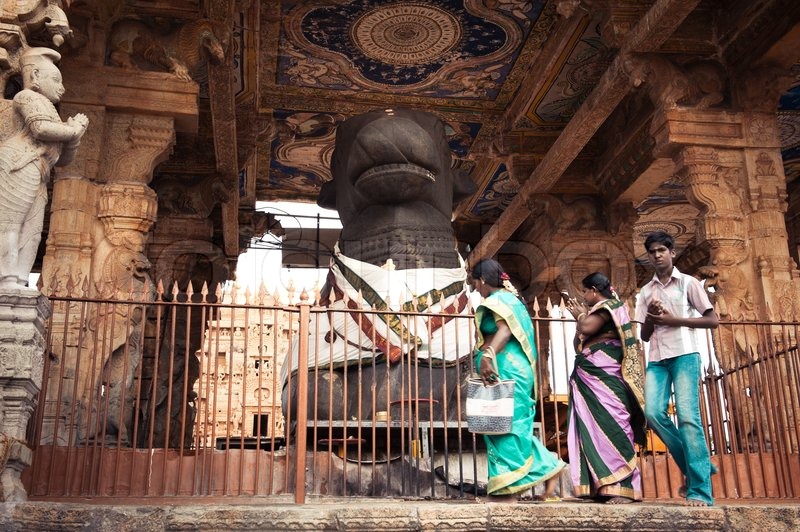
big statue of Nandhi (sacred bull), measuring about 16 feet long and 13 feet
high is present at the entrance and it is made up of a single rock. The
octagonal Shikharam rests on a single block of granite, weighing 81 tons. There
are hundreds of figures decorating the Shikharam and they are believed to have
been constructed during Maratha period. Huge Nandis dot the corners of the
Shikharam, and the Kalasam on top is about 3.8 meters in height by itself. The
Shivalingam measures up to 3.7m, set in a two storeyed sanctum. The walls
surrounding the sanctum are adorned with many of the frescoes, which had been
discovered only a few decades earlier. It is said to be the only temple in
India, wherein the builder (Rajaraja Chola I) had left behind a very large
number of inscriptions divulging the temple’s various parts, the daily rituals
to be performed for the Lingam, the details of the offerings such as jewellery,
flowers, textiles, the special worships to be performed on the days when they
should be done exactly, the monthly and the annual functions and so on. The
emperor even arranged an astrologer, “Perukani” for inscribing the dates of the
festivals based on the planetary movements.
It is said to be the
only temple in India, wherein the builder (Rajaraja Chola I) had left behind a
very large number of inscriptions divulging the temple’s various parts.
The inscriptions were
the master work done by the king. It contains 107 paragraphs instructed by him
seated in the royal bathing hall at the eastern side of his palace. The
instructions were provided for carving the details like, how his order should
be adorned at the base of Vimana, how he executed the plan for construction of
the temple, the list of gifts given by him, his sister Kundavi, his queens and
by others to the temple, including a list of 66 beautiful bronze idols. It also
elaborates the temple’s enormous golden jewellery inlaid with diamonds,
emeralds, rubies, sapphires, corals, pearls, for decorating each of these
bronze idols. The measurements of the gems used from the head to toe of the
bronze idols have also been provided as also the number of arms the idols have
and the symbols held in the arms. The inscriptions also reveal financial
information on the construction of the temple. It is a sad fact that only two
bronze idols are available in the temple today – one that of a dancing Shiva
and another of his consort Sivagami. The other bronze idols have disappeared.
Legends:
After the death of the patron, Rajaraja Chola I, his son
Rajendra I who was a great military leader succeeded him in 1014. During his
reign, he extended the territory of already vast Chola Empire up to the banks
of the river Ganges in the north and across the ocean. He shifted the capital
of the Chola kingdom to Gangaikondacholapuram, about 60km away, and started
building a new temple there, as he wanted to build a bigger version of “The Big
Temple”. Rajaraja Chola I donated a big amount of money for the maintenance of
the Periya Kovil. But, Rajendra I had diverted all the money for the
construction of his new temple. His decision deprived the Big Temple of royal
patronage. However, Rajendra was able to build only a smaller version of the
Big Temple, eventually. Further more, the Cholas built hundreds of temples along
the banks of the River Cauvery, changing its landscape forever. None of the
forts and palaces built by the Cholas survives today. But the temples remain
and they stand testimony to their achievements. They are also a major tourist
attraction for both local and foreign visitors.
Exquisite carving of
the Nandi, the bull which serves as the mount of Lord Shiva.
Popularity:
Thanjavur Periya Koil
is the grandest creation of Cholas and it is visible from any area in
Thanjavur, perhaps the only temple with such a characteristic.
This temple is part of
the UNESCO World Heritage Site “Great Living Chola Temples”. The temple became
popular all over the country on its 1000th birthday in
September 2010. In its commemoration, a rupees postage stamp, featuring the
216-feet tall Raja Gopuram (Vimana) was released by the India Post. A 5 rupee
coin was released by the Reserve Bank of India. A 1000 Rupees Commemorative
Coin (with the same picture on the 5 rupees coin) of Thanjavur Periya Kovil
will be issued soon. This will be the first 1000 Rupees coin to be released in
the Republic of India coinage, but it will not be for public circulation (In
April 1954, the Reserve Bank of India had released a 1000 rupees currency note
with panoramic view of the temple. Later, during the Indira Gandhi rule, all
1000 rupees notes were demonetized to curtail black money.)
Getting
There:
Bus service is
available to Thanjavur from all the major cities like Trichy, Chennai,
Kumbakonam, Pudukkottai, Pattukkottai, Tirunelveli, Karur, Nagapattinam,
Coimbatore, Erode and many other cities in the state. Trains run from many
cities across India including Chennai, Trichy, Coimbatore, Erode, Tirunelveli,
Madurai and Nagore. The train station is Thanjavur Junction. Tiruchirapalli
Airport is the nearest airport, located 65 km away.
Source:
https://tamilnadu.com/travel/tanjavur-periya-kovil.html
Comments
Post a Comment